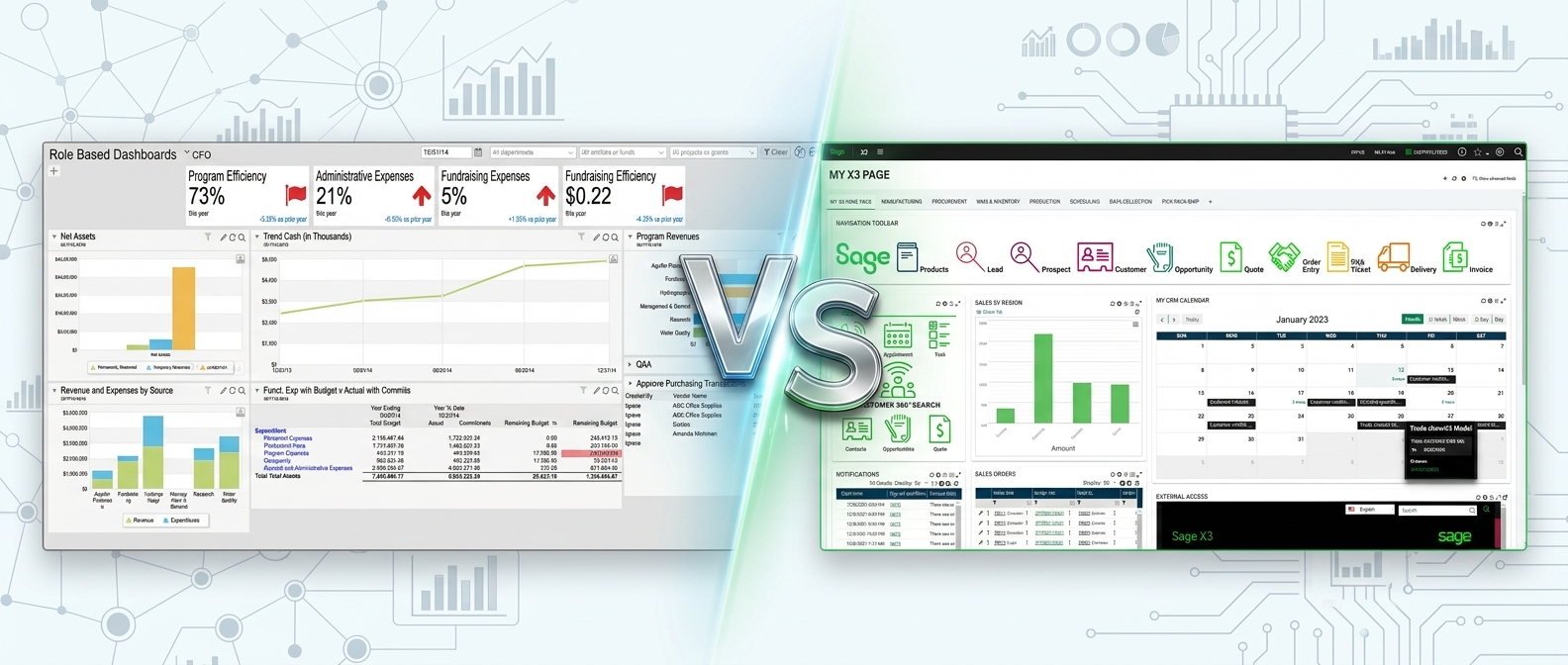
When scaling a mid-market or enterprise organisation, outgrowing entry-level software like QuickBooks or Sage 50 is a common milestone. However, choosing your next system can be confusing—especially when evaluating options within the same vendor ecosystem.
Sage offers two heavyweights: Sage Intacct and Sage X3. While both provide robust financial management, they serve fundamentally different organisational needs, operational workflows, and business models.

System Architecture: Cloud-Native vs. Flexible Deployment
The foundational difference between these systems lies in how they were built and deployed.
- Sage Intacct is a cloud-native SaaS solution. It runs on Sage’s multi-tenant cloud infrastructure, receiving continuous automatic updates. There is no hardware to maintain, no IT infrastructure to manage, and integrations are built using open, RESTful APIs.
- Sage X3 is a flexible ERP. It can be hosted in the cloud (single-tenant / partner-managed) or deployed on-premises. This makes X3 the preferred choice for enterprises bound by strict regulatory, data residency, or legacy infrastructure requirements.
Core Capabilities: Financial Precision vs. Operational Control
Sage Intacct: Built for Financial Excellence
If your main bottleneck is complex accounting, Sage Intacct delivers unmatched power:
- Dimensional Accounting: Instead of managing a massive, bloated Chart of Accounts, Intacct uses tag-based "dimensions" (e.g., location, project, vendor, department) to filter and analyse financial performance dynamically.
- Multi-Entity Consolidation: Handles complex multi-currency, multi-entity setups with automated intercompany eliminations in seconds rather than days.
- Best-of-Breed Integration: Built to connect seamlessly with sales tools (Salesforce), payroll, and specialised billing software via standard APIs.
Sage X3: Built for Operations & Manufacturing
If your revenue depends on physical inventory, complex BOMs (Bills of Materials), or shop-floor scheduling, Sage X3 is designed for the job:
- End-to-End Supply Chain: Manages purchasing, warehouse routing, bin tracking, logistics, and quality assurance under one roof.
- Production Planning: Supports both discrete (assembly, machinery) and process (recipes, formulas, lot traceability) manufacturing out of the box.
- Global Operations: Natively configured to handle multi-site, multi-language, and localised tax compliances across complex international manufacturing footprints.
Ideal Use Cases: Which One Fits Your Business?
Choose Sage Intacct if:
- You are a service-led or subscription business: SaaS, professional services, non-profits, healthcare, or financial firms needing revenue recognition and subscription management.
- You want minimal IT overhead: You prefer a pure cloud solution where updates happen automatically in the background.
- Your primary challenge is financial visibility: You need quick month-end closes, advanced board-ready dashboards, and real-time reporting across multiple business entities.
Choose Sage X3 if:
- You make, process, or distribute physical products: Food and beverage, chemicals, life sciences, electronics, or industrial manufacturing.
- You need shop-floor and inventory depth: Requirements include lot/serial batch tracking, Material Requirements Planning (MRP), quality control workflows, or barcode scanning integrations.
- You require deployment control: Your industry demands custom hosting setups, air-gapped security, or on-premises server management.
Final Decision Framework
Choosing between Sage Intacct and Sage X3 comes down to your operational model:
- Finance-Led Growth: If your core operations revolve around contracts, projects, software, or multi-location services, Sage Intacct offers the agility and financial depth you need.
- Product-Led Growth: If your day-to-day operations involve raw materials, supply chains, manufacturing floors, or global distribution networks, Sage X3 provides the end-to-end operational control required.