BEYOND THE HYPE: A PRAGMATIC LOOK AT ERP UPGRADES FOR THE MID-MARKET
Recent coverage across ERP Today and Enterprise Times paints a picture of a software market obsessed with artificial intelligence and seamless cloud migrations. From SAP pushing its latest cloud editions to Microsoft embedding AI assistants into every corner of Dynamics 365, the daily news feed is deafening. But when you strip away the vendor brochures, what does this actually mean for a mid-market business?
As an independent analyst, my job is to look past the announcements. Here is a grounded look at what the current enterprise software landscape actually offers mid-sized organisations, the hidden traps of vendor lock-in, and where the real return on investment hides.
THE TIER-ONE GIANTS PUSHING DOWNMARKET: SAP, ORACLE, AND MICROSOFT
It is no secret that SAP and Oracle have saturated the top-tier enterprise space and are aggressively targeting the mid-market to maintain growth. Microsoft continues to leverage its sheer ubiquity to bundle Dynamics 365 into broader corporate IT strategies.
The Pros
The primary advantage of these giants is their massive research and development budgets. If you want the most advanced machine learning for supply chain forecasting or financial automation, they have it. They offer robust, scalable platforms that a growing business will practically never outgrow.
The Cons and Lock-In Risks
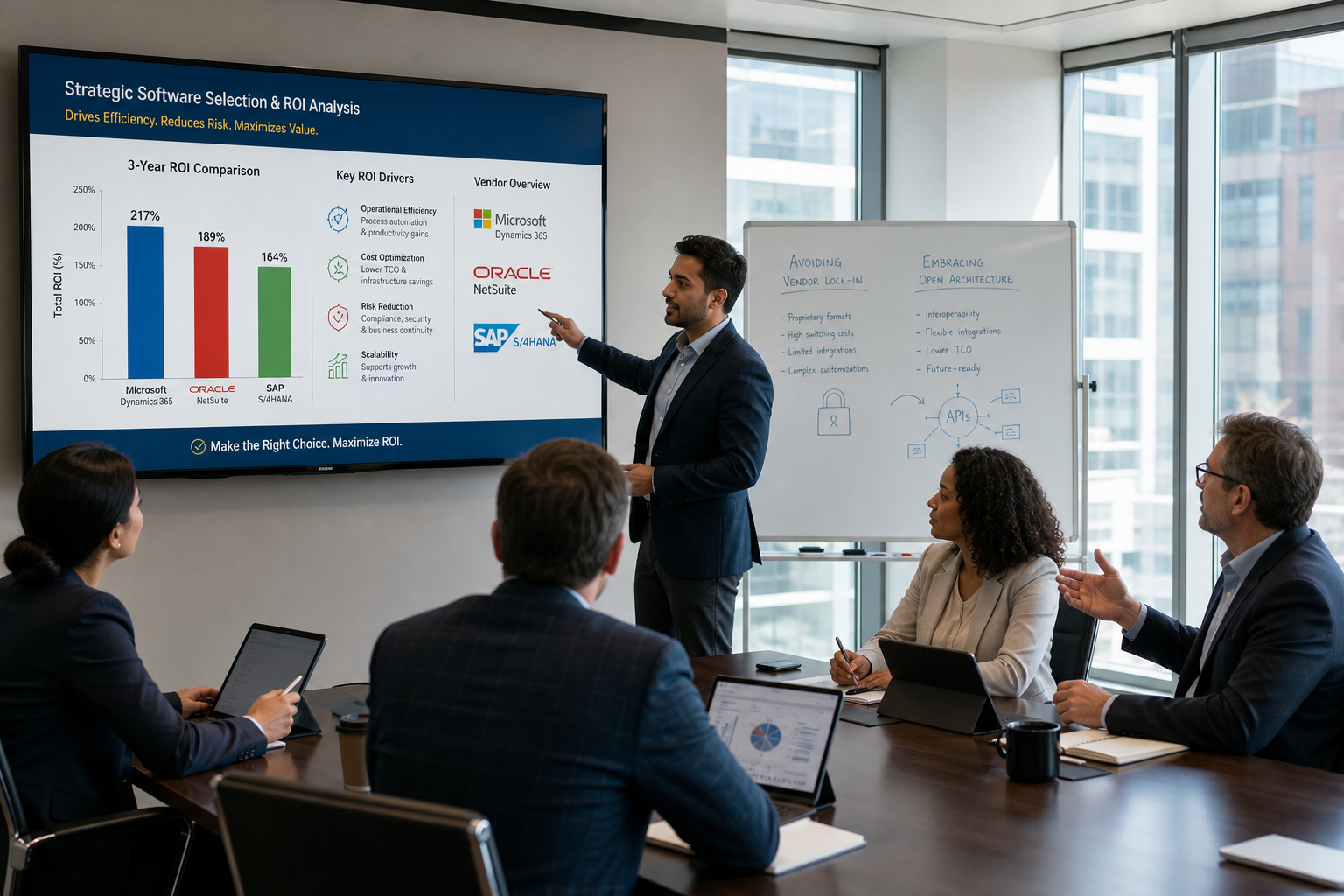
The trap here is the ecosystem snare. Microsoft offers brilliant connectivity between Office, the Power Platform, Azure, and Dynamics. However, once your business processes are hardcoded into this web of proprietary tools, leaving becomes financially and operationally impossible. SAP and Oracle carry similar risks with their strict cloud contracts and complex licensing structures. You are not just buying software; you are marrying the vendor, which severely weakens your bargaining power at renewal time.
The Actual ROI
For mid-market firms, the ROI with tier-one vendors is a long game. Expect a timeline of 18 to 24 months before you realise a true financial return. The payoff comes from standardising chaotic, disparate global operations into a single source of truth, typically resulting in a 10 to 15 percent reduction in operational overhead once fully adopted.
THE INDUSTRY SPECIALISTS: ACUMATICA, EPICOR, INFOR, SAGE, AND SYSPRO
While the giants try to scale down, vendors like Acumatica, Epicor, Infor, Sage, and Syspro are aggressively defending their home turf. Recent industry feeds highlight their focus on industry-specific editions, particularly for manufacturing, distribution, and retail.
The Pros
These solutions speak your language out of the box. Syspro and Epicor do not need to be taught how a factory floor works. Infor provides deep, micro-vertical cloud suites designed for highly specific trades. Acumatica offers a consumption-based pricing model that does not penalise you for adding occasional users, while Sage Inacct remains a reliable powerhouse for financial-led mid-market firms. They require far less expensive customisation than the tier-one platforms.
The Cons and Lock-In Risks
The lock-in risk with mid-market specialists often lies in the talent pool and niche platform architecture. Finding an independent specialist developer for these systems can be harder than finding a ubiquitous Microsoft or Oracle expert. Furthermore, if your business model makes a massive pivot, these highly tailored platforms might struggle to adapt with you.
The Actual ROI
These vendors offer a much faster time to value. Mid-market businesses typically see ROI within 9 to 12 months. Because the systems are tailored to specific industries, you spend less time configuring and more time optimising. Real-world returns usually manifest as a 15 to 20 percent reduction in inventory holding costs and significantly faster order-to-cash cycles.
THE PEOPLE AND ASSET FOCUSED PLAYERS: IFS, UNIT4, AND WORKDAY
Not every business makes physical widgets. For service-centric, asset-heavy, or people-driven organisations, IFS, Unit4, and Workday are frequently headlining industry news.
The Pros
Workday dominates the human capital and financials space with a modern interface that employees actually want to use. Unit4 is exceptionally strong for project-based professional services and public sector work. IFS remains unrivalled for companies that manage complex physical assets and remote field service teams.
The Cons and Lock-In Risks
The danger here is module dependency and data gravity. Workday is fantastic for HR, but you may find their financial modules are priced at a premium. Once your workforce data is deeply embedded in their proprietary cloud architecture, data extraction during a platform migration is notoriously difficult. With IFS, the sheer depth of the asset management features means your maintenance teams will refuse to use anything else, giving the vendor significant leverage.
The Actual ROI
ROI for these vendors is measured differently. For Workday and Unit4, it is found in better resource utilisation, often improving billable utilisation rates by 5 to 8 percent and reducing staff turnover through better user experiences. For IFS, the ROI comes from extending the lifecycle of expensive physical assets and reducing unplanned downtime, which can save asset-heavy businesses millions annually.
THE INDEPENDENT VERDICT
The news feeds want you to believe that AI assistants and automated cloud systems are silver bullets for mid-market efficiency. They are not. Software is merely an amplifier of your existing processes.
When selecting your next platform, ignore the glossy AI promises. Ask the vendors how much data egress fees will cost if you decide to leave. Look at how many customisations you will need to simply run your core business. For a mid-market business, the best system is not the one with the most features; it is the one that forces you to simplify your operations, gets adopted by your staff, and allows you to retain control of your own operational destiny.