The Mid-Market ERP Reality Check: Cutting Through the Noise to Find Real ROI
Recent announcements across the ERP landscape reveal a stark divide between what software vendors are selling and what mid-market businesses actually need. If you follow the latest updates from the major industry feeds, you would think artificial intelligence is a magic wand that instantly resolves supply chain bottlenecks and reconciles ledgers. As an independent analyst, I look past the glossy presentations to see what this actually means for your balance sheet.
The Heavyweights: High Power, High Trap
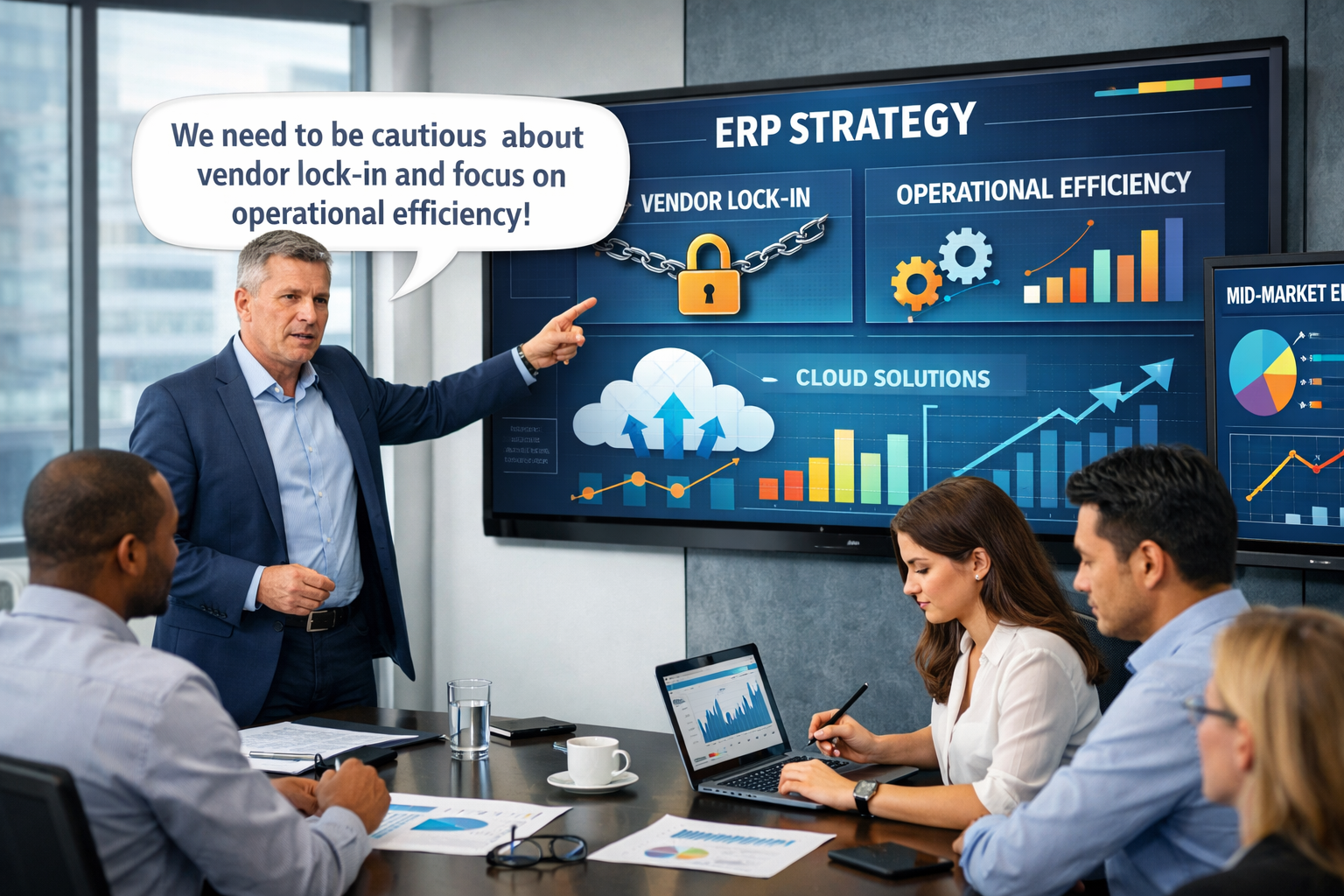
Let's look at the enterprise heavyweights aggressively pushing down into the mid-market. SAP continues to heavily promote its cloud-only transformation programmes. The pro here is access to top-tier, global best practices and highly advanced predictive analytics. However, the vendor lock-in risk is severe. By pushing customers exclusively into their premium cloud environments to access new features, SAP makes future migration prohibitively expensive. The ROI for a mid-market firm only materialises if you are willing to completely standardise your operations to fit their strict mould.
Microsoft and Oracle are playing a similar game. Microsoft Dynamics 365 is deeply embedding its AI copilots into every screen. The productivity gains are genuinely impressive—automating supplier communications and predicting cash flow anomalies saves tangible labour hours. Yet, the trap is ecosystem lock-in. Once your team relies on the seamless interplay between Teams, Office, and Dynamics, negotiating your renewal rates in three years becomes nearly impossible because the cost of untangling your business from the Microsoft ecosystem is too high.
The Mid-Market Specialists: Pragmatism Over Polish
This is where the mid-market specialists offer a distinctly different value proposition.
For manufacturers and distributors, Infor, Epicor, and Syspro are delivering highly practical updates. Instead of broad, sweeping AI claims, they are focusing on pragmatic machine learning on the shop floor. Infor’s micro-vertical approach and Epicor’s focus on predicting equipment failure and optimising inventory mean the ROI is highly measurable. You can directly track reduced machine downtime and lowered holding costs. The con? Their user interfaces and broader HR capabilities often feel less polished than the mega-vendors, meaning you might still need external software for non-core functions.
Acumatica and Sage continue to champion open architectures and flexible pricing. The core advantage of this composable approach is the direct mitigation of vendor lock-in. If a specific module isn't delivering, you have the flexibility to integrate a third-party tool via open APIs without breaking your core financial system. However, the downside is that managing multiple integrations requires internal IT rigour, which many mid-market businesses simply lack.
For service-based organisations, Workday, IFS, and Unit4 are fighting for dominance. IFS excels in field service and asset management, offering modular upgrades that allow you to only pay for what you use—a massive pro for capital preservation.
Workday brings enterprise-grade HR and finance together in a unified data core, but its mid-market implementation requires significant upfront investment. The ROI with Workday comes entirely from workforce optimisation and reducing employee turnover. Unit4 offers a lighter, more agile alternative for professional services, focusing on user experience to drive adoption. The risk with all three is data gravity; once your complex project structures and employee lifecycles are mapped into their proprietary formats, migrating to a competitor requires a fundamental rebuild of your business logic.
The Verdict on ROI
Where is the actual return on investment for a mid-market business today? It is rarely in the headline-grabbing AI chatbots. Real ROI comes from mundane efficiency: automating invoice processing, shrinking month-end close from ten days to three, and having a single, reliable source of truth for inventory.
When evaluating your next ERP move, focus heavily on data portability. Vendors are currently using advanced features as a golden cage—the tools are brilliant, but once you are inside, they hold the keys. Ensure your contract includes clear, low-cost offboarding clauses for your data. Choose a system that fits your operational reality today, not a vendor's utopian vision of tomorrow.